
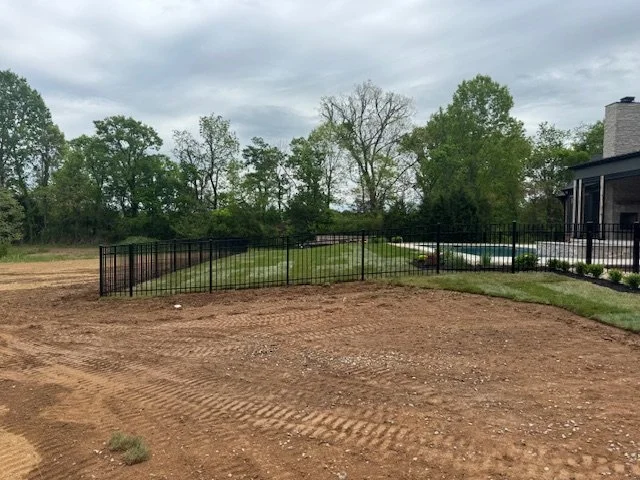
Fence line running along the grade of an open Middle Tennessee property

Farm & Ranch Fence Installation in Middle Tennessee

Long frontage, clean rails, real posts in the ground.

Acreage fencing is a different job from a suburban back yard. Runs are long, terrain varies, and the fence has to define frontage attractively while doing real work at the property line. We install three and four board farm fence, ranch rail and wire backed systems.

Styles

Three board, four board, ranch rail

Options

No climb wire backing

Best for

Acreage, frontage, pasture

Terrain

Rolling ground and long runs

Board fence that stays in line across acreage

On a five hundred foot run, small errors compound. We pull the line properly, keep post spacing consistent, and set corner and brace posts so tension and terrain do not slowly pull the run out of true.

Boards are run to follow the grade in a smooth line, which is what makes traditional Middle Tennessee horse fence look right from the road.

  • Three board and four board configurations
  • Braced corners and gate posts
  • No climb or field wire backing for livestock and dogs
  • Entry gates sized for equipment and trailers

Wire backing when the fence has a job

Board fence alone looks good but will not hold small livestock or dogs. Adding no climb wire on the interior gives you containment without changing the appearance from the road. We fasten it so it stays tight rather than bowing between posts.

Gates and entries

Farm entries take abuse from trucks, trailers and tractors. Gate posts are the most loaded element on the whole fence, so they are set deeper, braced and sized for the swing weight. Where an automatic entry gate is wanted, we plan power and the gate operator location during layout rather than trenching back through a finished driveway later.

Corners and braces carry the fence

A rail fence does not fail in the middle of a run. It fails at the corners, ends and gate openings, where the pull of the entire line concentrates. Those posts need to be larger, set deeper, and braced back into the line so the tension has somewhere to go.

On long frontage runs across Wilson and Rutherford County acreage, that is where the real construction happens. The rest is repetition. A quote that prices every post the same way is telling you something about how the fence will be built.

Adding containment to a rail fence

Board or vinyl rail defines a boundary but does not contain small livestock, dogs or poultry. Woven wire or welded wire mesh attached on the interior face handles that without changing how the fence looks from the road.

We ask what the fence has to hold before quoting it, because the answer changes rail spacing, height and whether mesh is part of the build.

Common questions

Answers before you ask.

Do you fence acreage outside the main cities?

Yes. We work across Rutherford, Williamson, Wilson and Davidson County, including the rural areas between them. Tell us the property location and total footage in your estimate request.

Can you add wire to an existing board fence?

In most cases, yes, provided the posts and boards are sound. We will tell you honestly if the existing structure is not worth backing.

What is the difference between ranch rail and board fence?

Ranch rail typically uses heavier, wider rails inset or attached to posts for a rustic look, while board fence uses standard boards face mounted. Both can be built with two, three or four rails.

How far apart do rail fence posts go?

Spacing depends on the rail material and length, and on whether wire is being attached. We set it for the specific build rather than to a default that stretches material further.

Get an estimate

Ready to talk through your project?

Send the property address, what you are looking to build and a few photos of the area. We will follow up to schedule a site visit and put together a clear, detailed quote.