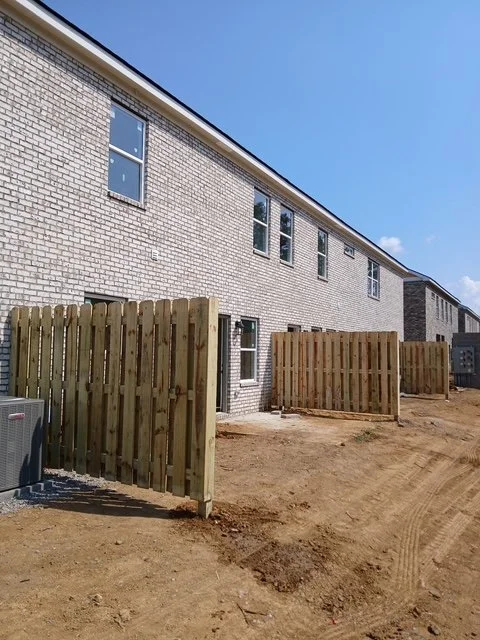
Wood privacy fence with a matching swing gate installed beside a brick home

Board on Board Fence Installation in Middle Tennessee

Finished on both sides, with no gaps when the wood moves.

Board on board is the upgrade from a standard privacy fence. Pickets are overlapped rather than butted together, so the fence looks finished from both sides and stays fully private even after the boards shrink through their first dry season.

Look

Finished both sides

Privacy

No gaps as wood dries

Best for

HOA neighborhoods, street facing lines

Materials

Cedar or pressure treated pine

Why the overlap matters

A conventional privacy fence sets pickets edge to edge. Lumber dries and shrinks, and within a year those tight joints open into gaps you can see straight through. Board on board overlaps every picket by an inch or more, so shrinkage never becomes a sight line.

The overlap also creates depth and shadow along the fence, which reads far better from a patio than a flat wall of boards.

  • Overlapping pickets that stay private as lumber shrinks
  • Same finished appearance from your yard and the street
  • Optional cap and trim board for a framed top line
  • Works with a stepped or racked layout on grade

The HOA friendly wood option

Because there is no unfinished rail side, board on board satisfies associations that require the good side to face out, and it looks intentional on the portions of a fence line visible from the road. Adding a top cap and trim board raises the finish level further and gives the fence a defined edge.

Built with the same structure standards

Board on board uses more lumber than a standard privacy fence, so the framing has to carry more weight. Posts are set to depth in concrete, rails are sized for the span, and gates are braced and hung on reinforced posts so the extra picket weight does not pull them out of square.

Why the overlap is worth paying for

A standard privacy fence butts boards edge to edge. Wood shrinks, and within a year or two you can see daylight through gaps that were tight on install day. Board on board overlaps each picket with its neighbor, so seasonal movement never opens a sight line.

The second benefit is appearance. Because both faces show a finished board pattern, there is no good side and bad side to negotiate with a neighbor. On a fence that both households look at every day, that matters more than homeowners expect it to.

Common questions

Answers before you ask.

Is board on board worth the extra cost?

If the fence is visible from the street, shared with a neighbor, or you want privacy that does not open up as the wood dries, it usually is. On a back property line behind a tree row, a standard privacy fence may be the better value.

Can board on board be stained?

Yes, and staining is recommended in this climate. The overlap adds surface area, so plan on a bit more material than a flat privacy fence of the same length.

How tall can a board on board fence be?

Six feet is standard for residential privacy. Local rules and HOA guidelines set the ceiling, and front yard heights are usually restricted well below rear yard heights.

How much more does board on board cost than standard privacy?

It uses noticeably more material because of the overlap, so it prices above a standard privacy fence of the same height. We quote both side by side so you can decide with the real numbers.

Get an estimate

Ready to talk through your project?

Send the property address, what you are looking to build and a few photos of the area. We will follow up to schedule a site visit and put together a clear, detailed quote.